T: +86-139-5050-9685
E: sales@bycpower.com
E: sales@bycpower.com
No. 13, Jincheng road, Tiehu village, Chengyang town, Fuan city, Fujian, China


Views: 0 Author: Site Editor Publish Time: 2026-06-02 Origin: Site


Mission-critical facilities require scalable, fail-safe power to keep operations running during grid outages. Relying on a single massive generator creates a dangerous single point of failure for any site. It also causes highly inefficient fuel consumption during partial loads. Facility managers often face the dilemma of balancing maximum redundancy against operational efficiency. A single massive unit forces you into rigid maintenance windows and high fuel burn rates. You need a system capable of adapting dynamically to facility demands without sacrificing uptime.
A parallel control cabinet enables multiple smaller generators to act as one cohesive, intelligent grid. This article provides a clear evaluation of the business case and technical prerequisites for these modern systems. You will learn implementation realities to help specify a resilient multi-generator power setup. We will cover synchronization logic, infrastructure design, and vendor selection strategies.
Enhanced Reliability: N+1 and N+2 configurations can push system availability from 98% to 99.999% by eliminating single points of failure.
Operational Efficiency: Paralleling allows units to run in their optimal 70–80% load band, drastically reducing fuel waste and engine wear.
Reduced Complexity: Modern integrated controllers eliminate the need for massive, legacy switchgear, reducing commissioning time from weeks to days.
Implementation Reality: Successful deployment requires strict attention to Power Management System (PMS) tuning, harmonic distortion risks, and local compliance (e.g., NFPA 110).
Evaluating facility power systems requires looking beyond upfront hardware prices. While the initial setup of multiple smaller units carries a higher CapEx, the long-term operational savings often yield a much stronger return on investment. You spend less on fuel, engine repairs, and emergency service calls. The flexibility of modular power mitigates the financial risks of unexpected facility downtime.
Large single generators suffer heavily when running at low loads. Diesel engines operating below 30% of their rated capacity experience poor fuel economy and "wet stacking." Unburned fuel accumulates in the exhaust system, destroying engine efficiency and causing premature mechanical failure. A multi generator system solves this dynamically. It spins units up or down to keep active engines operating in their optimal 70–80% load band. This intelligent deployment ensures you only burn the fuel you actually need.
Redundancy represents the greatest advantage of paralleling. If one unit requires maintenance, a parallel system maintains your critical loads seamlessly. A basic N+1 setup boosts reliability exponentially. You gain concurrent maintainability, meaning technicians can service individual engines without dropping facility power. Your facility transitions from relying on brute force to utilizing an intelligent, adaptable power network.
Feature | Single Large Generator | Multi-Generator Parallel System |
|---|---|---|
Reliability & Uptime | Single point of failure. Outages required for maintenance. | N+1/N+2 redundancy. Zero-downtime maintenance. |
Fuel Efficiency | High fuel waste during low-demand periods. | Optimized load scaling saves significant fuel. |
Scalability | Fixed capacity. Cannot easily expand later. | Modular. Add new units as facility demand grows. |
Modern electrical infrastructure relies on automation. Advanced parallel controllers actively match incoming generators to the existing bus or grid. Automated synchronization continuously monitors the electrical waveforms. The system adjusts engine speed and alternator voltage precisely before allowing breakers to close. This prevents the catastrophic electrical transients common in manual setups.
Once connected, precision load sharing becomes critical. A well-configured load sharing cabinet prevents individual generator overload. It proportionally distributes both active power (kW) and reactive power (kVAR) across the entire system. If one engine bogs down, the cabinet detects the deviation and instantly commands the other units to absorb the transient spike.
The Power Management System (PMS) orchestrates the entire operational lifecycle. We can break down this automated sequence into specific phases:
Auto-Starting: The system detects utility failure or high facility demand and commands the necessary engines to crank.
Synchronizing: Controllers trim voltage and speed until waveforms align perfectly with the bus.
Breaker Closure: The system closes the paralleling breaker at the exact millisecond of phase alignment.
Load Ramping: The system shifts facility load onto the newly connected unit smoothly.
Graceful Disconnect: As demand drops, the PMS removes load from excess units, opens their breakers, and initiates cool-down cycles.
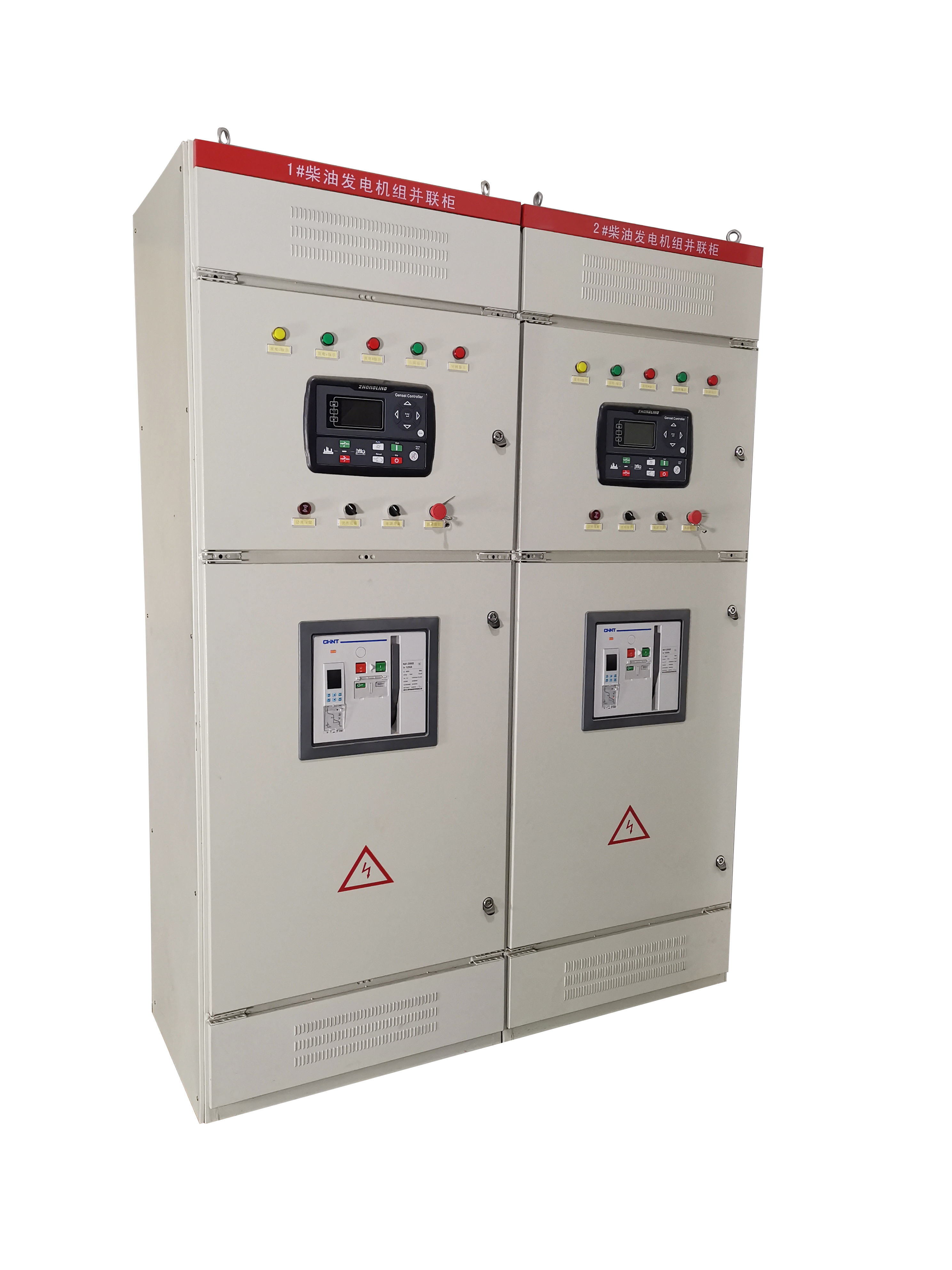
Legacy paralleling systems plagued engineers for decades. Traditional third-party switchgear carried massive physical footprints and astronomical costs. Facility owners routinely paid $25,000 to $30,000 per section just for control logic hardware. These legacy setups demanded extreme complexity. A simple dual-genset deployment often required 9 to 14 independent micro-controllers to handle speed bias, voltage matching, and breaker protection.
The industry eventually shifted toward an integrated approach. Equipment manufacturers now embed synchronization logic directly into engine-mounted controllers. This onboard generator parallel control simplifies the entire power architecture. Consolidating load sharing and protection into a single module eliminates miles of complex control wiring. You reduce the number of potential failure points drastically.
Faster commissioning stands out as a major operational victory. Modular, factory-tested parallel systems arrive pre-configured. Engineers reduce on-site integration and troubleshooting from several weeks down to just a few days. You spend less time resolving communication errors between mismatched third-party controllers and more time verifying actual load performance.
Electrical physics governs the paralleling process strictly. To prevent catastrophic electrical conflicts, any synchronized generator set must satisfy four hard electrical rules before breaker closure. Failure to meet these conditions results in severe mechanical damage to engine crankshafts and alternators.
Phase Sequence: Phases must align perfectly (A-B-C to A-B-C) to prevent massive three-phase imbalances.
Voltage Levels: Alternator outputs must match bus voltage closely to minimize reactive current surges.
Frequency: Units must lock strictly at 50Hz or 60Hz.
Phase Angle: Electrical waveforms must overlap exactly at the moment of breaker closure.
We must look closer at the engineering reality of Isochronous versus Droop control. Once magnetically locked to an AC bus, adding fuel to a diesel engine does not increase its speed. It strictly increases torque and electrical amps. Starting an engine in Isochronous mode allows precise speed matching for initial synchronization. Switching to Droop mode immediately after breaker closure is an engineering best practice. Droop allows the engine frequency to dip slightly as load increases, forcing multiple machines to share power smoothly instead of fighting for dominance.
You must address system challenges proactively. Poorly tuned PMS pulse lengths present significant risks. If the controller sends speed correction pulses that are too long, the system will experience aggressive load hunting. Unstable frequencies follow, generating damaging harmonic distortion. This distortion rapidly overheats sensitive facility electronics and uninterruptible power supply (UPS) systems.
Successful deployment requires choosing the right isolation topology. You must weigh initial space constraints against future maintenance needs. A robust power control cabinet integrates directly into your broader electrical distribution strategy. We recommend evaluating two primary deployment configurations:
Topology Type | Advantages | Disadvantages |
|---|---|---|
Direct to ATS | Lowest initial cost. Minimal physical footprint required. | Requires full system shutdown for thorough switchgear maintenance. |
Double-Breaker Configuration | Maximum safety. True zero-downtime maintenance capability. | Highest initial cost. Requires significantly larger switchgear room space. |
Decision-makers must look beyond simple electrical wiring constraints. Fuel storage compliance heavily impacts facility design. Standards like NFPA 110 cap the amount of fuel you can store safely indoors. For long-term standby systems, these regulations often mandate automated fuel polishing systems to prevent diesel degradation over time. Ignoring these standards risks failed inspections and degraded emergency power readiness.
Airflow and acoustics present major mechanical hurdles. Multi-engine rooms generate massive exhaust noise and heat rejection. You must conduct wind-rose graph studies to understand local prevailing winds. Acoustic louvers are necessary to suppress noise, but they create static pressure drops. Your radiator fans must overcome this resistance to prevent the engines from derating due to high temperatures.
Advanced controllers offer excellent future-proofing capabilities. Secondary and tertiary control levels allow you to integrate battery energy storage systems (BESS) and renewable sources alongside diesel units. This microgrid approach facilitates peak shaving and energy arbitrage. You can dispatch batteries during brief load spikes, reserving the diesel units for sustained utility outages.
Facility managers should design their electrical infrastructure with a 10-to-20-year master plan in mind. Oversize your main switchgear bus during initial construction. This foresight allows future generators to "plug and play" seamlessly. You avoid the massive expense of tearing out and replacing the main cabinet when the facility expands.
Establish strict vendor evaluation criteria early in the design phase. Shortlist vendors who offer single-source responsibility. When one manufacturer designs the engine, alternator, and parallel controller simultaneously, integration becomes seamless. This unified approach eliminates finger-pointing between different contractors during complex site commissioning and emergency troubleshooting.
Transitioning from a single massive engine to a parallel system represents a strategic shift from brute force to intelligent power management. Redundant multi-generator architectures protect your facility against catastrophic single-point failures while optimizing fuel consumption. Although initial engineering demands are rigorous, the operational resilience achieved is undeniable.
Ensure you prioritize proper PMS tuning and robust acoustic design during the planning stages. Evaluate your isolation topology carefully to guarantee safe, concurrent maintainability over the system's lifespan. By embracing advanced paralleling technology, modern data centers, hospitals, and manufacturing facilities can secure highly scalable, fail-safe power for decades to come.
A: Paralleling out of phase causes catastrophic electrical and mechanical events. The voltage differences create massive current spikes. These surges will trip breakers instantly. If protections fail, the extreme magnetic forces will severely damage alternator windings and can physically snap the engine's crankshaft due to violent torque deceleration.
A: Yes, but it complicates the engineering significantly. You need advanced controllers to manage different transient response times and enforce proportionate load sharing. While possible, utilizing identical generator models is vastly preferred to ensure stable frequency responses and minimize complex tuning requirements.
A: Synchronization is the prerequisite phase. It matches the electrical waveforms, voltage, and frequency of the incoming generator to the bus before the breaker closes. Load sharing is the ongoing, active distribution of real (kW) and reactive (kVAR) power demand across all connected units after the breakers are closed.