T: +86-139-5050-9685
E: sales@bycpower.com
E: sales@bycpower.com
No. 13, Jincheng road, Tiehu village, Chengyang town, Fuan city, Fujian, China


Views: 0 Author: Site Editor Publish Time: 2026-05-28 Origin: Site


Securing reliable off-grid power represents a critical logistical hurdle for many industries today. Planners for outdoor events, remote construction sites, and emergency response teams face this massive challenge daily. You need stable, continuous electricity exactly where the standard utility grid falls short. Commercial-grade trailer units solve this complex problem efficiently. Unlike heavy stationary units or light-duty portable inverters, these systems bridge the crucial gap between heavy-duty electrical output and rapid field mobility. You gain access to massive power levels without sacrificing quick deployment speeds. Evaluating the right equipment requires balancing exact power demands, strict noise compliance rules, and physical site logistics. In this comprehensive guide, you will learn how to size your equipment properly to avoid engine damage. We will also cover acoustic placement strategies and crucial grounding safety protocols. These practical insights will help you deploy mobile power safely and reliably.
Sizing matters: Factor in 3–5x starting surge for motor loads, plus a 25% safety margin, to avoid both power drops and engine "wet stacking."
Placement logistics: Sound-attenuated enclosures allow closer placement (15-20 meters), drastically reducing heavy cable rental costs and voltage drop risks.
Compliance first: Road-legal towing requires DOT-compliant chassis, while operation demands strict grounding protocols and emissions compliance (e.g., EPA or Stage V).
Deployment speed: Integrated base fuel tanks and hitch-ready designs eliminate the need for flatbed transport and crane rigging.
Project managers must justify their equipment choices based on logistics, structural advantages, and deployment speed. Understanding these structural differences helps you streamline site operations effectively.
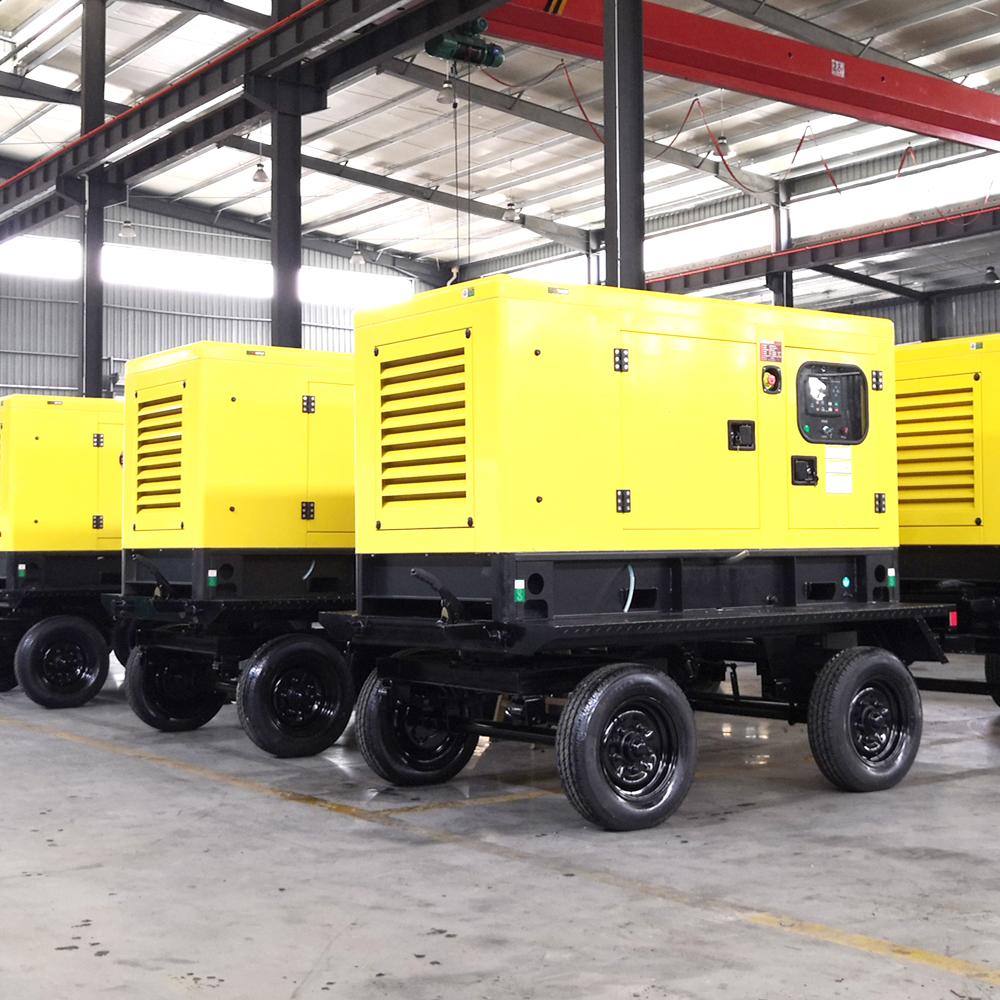
Skid-mounted generators sit on rigid steel frames. They require substantial external support to move. You must hire cranes or heavy-duty rough-terrain forklifts simply to place them on site. This adds logistical bottlenecks and expensive third-party rigging fees. In contrast, a trailer mounted generator offers true plug-and-play functionality. You simply hitch it to a standard work truck. You drive it exactly where you need power. This eliminates flatbed transport fees and drastically accelerates your site setup time.
Stationary units often require external fuel bladders and complex piping systems. Mobile units remove this headache completely. Most commercial chassis designs feature integrated base fuel tanks. These durable sub-base tanks typically hold enough diesel for 24 to 48 hours of continuous operation. You do not need to construct secondary containment berms. You avoid laying hazardous external fuel lines across busy work zones. This self-contained infrastructure maximizes your operational efficiency.
You must match your tow vehicle to the correct chassis classification. Towing requirements vary wildly based on the machine's physical footprint.
Open Deck Chassis: Lighter and more compact. Often used for smaller power nodes.
Integrated Tank Chassis: Heavier due to liquid fuel weight. They require robust suspension systems.
Payload Classes: Light units weigh roughly 3,500 lbs and utilize a single axle. Heavy commercial units exceed 10,000 lbs and require dual axles with heavy-duty braking systems.
Feature | Trailer Generator | Skid-Mounted Generator |
|---|---|---|
Mobility | Hitch-and-go with a standard truck | Requires cranes or heavy forklifts |
Deployment Speed | Immediate (Under 30 minutes) | Slow (Requires rigging and placement) |
Fuel Infrastructure | Integrated base tank (24-48 hours) | Often requires external fuel lines |
Site Relocation | Easy repositioning as project shifts | Static until heavy machinery arrives |
Matching equipment capabilities to specific industry pain points guarantees operational success. Different sectors face unique environmental and electrical challenges.
Music festivals, large weddings, and corporate retreats rarely happen near high-capacity grid infrastructure. An outdoor event generator powers massive concert stages, complex AV equipment, and high-draw food vendor areas. Acoustic canopies are absolutely critical here. You must preserve the attendee experience. Thick sound-attenuated enclosures absorb engine noise, keeping the event atmosphere pleasant and uninterrupted.
Civil contractors require rugged flexibility. A construction trailer generator supports rapid mobilization across multiple phases of roadwork. During early site preparation, they power temporary office trailers and hand tools. Later, they handle massive inductive loads to run tower cranes before grid tie-in occurs. Their mobility allows foremen to drag power exactly where the active work phase demands it.
When natural disasters strike, the utility grid fails instantly. First responders need immediate, decentralized power. Mobile units deploy within hours to crisis zones. They power medical triage tents with critical life-support equipment. They keep temporary housing clusters illuminated. They also provide vital energy to telecom towers, ensuring emergency communication networks remain online during rescue operations.
Film crews operate in highly isolated locations. They demand perfect voltage stability for sensitive cameras and lighting arrays. Telecom companies face similar strict requirements during network expansions or localized outages. Both industries view power density and high reliability as non-negotiable traits. Quiet operation prevents audio interference on movie sets, while continuous backup capabilities keep cellular networks functioning seamlessly.
Expert-level technical guidance is essential for capacity planning. Under-sizing causes catastrophic power drops. Over-sizing causes expensive engine damage. You must calculate your loads precisely.
Securing the right temporary power generator involves a strict mathematical approach. Guessing leads to failure. Follow these standardized sizing steps:
Inventory all running wattages: Create a spreadsheet listing every tool, light, and appliance connected to the grid. Sum up their continuous running watts.
Identify the highest single starting surge: HVAC systems, industrial chillers, and large motors draw massive initial currents. They often require three to five times their running current just to start turning.
Calculate the total: Add your total running wattage to the single highest starting surge wattage. You only add the largest surge because motors rarely start at the exact same millisecond.
Add a safety margin: Multiply your final number by 1.25. This 25% safety margin ensures the engine never runs continuously at 100% load, which prevents overheating.
Many operators mistakenly rent massive units for small loads "just to be safe." This approach ruins engines. Diesel engines require high operating temperatures for optimal fuel combustion. Running a mobile diesel generator at loads below 30% of its rated capacity prevents the cylinders from heating up. Unburned fuel and soot bypass the piston rings. This thick, black sludge builds up in the exhaust system. Mechanics call this phenomenon "wet stacking." It drastically reduces efficiency, creates severe fire hazards, and eventually destroys the engine block.
You can avoid wet stacking by utilizing paralleling systems. Instead of deploying one oversized unit, you link multiple smaller units together using camlocks and synchronized switchgear. If site demand drops, the system automatically powers down one unit. This keeps the remaining active units running at a healthy, high-load percentage. It provides scalable, intelligent power management.
Mitigating environmental impact prevents project shutdowns. Municipalities enforce strict noise ordinances. Poor placement strategy also creates massive hidden operational costs.
Sound behaves predictably in open spaces. Engineers rely on the inverse square law of sound to plan site layouts. Every time the distance from the noise source doubles, the perceived noise level drops by approximately 6 decibels (dB). For example, if a machine produces 75 dB at 7 meters, moving it to 14 meters drops the noise to roughly 69 dB. Understanding this mathematical rule helps you navigate local property-line noise limits effectively.
Physical distance heavily impacts your financial layout. You must balance noise reduction against copper cable expenses.
Open generators (~100 dB): These loud machines must sit 50 to 100 meters away from work zones. This massive distance requires thick, heavy-gauge copper cable rentals. These cables easily cost over $1,500 per month. Long runs also create dangerous electrical voltage drops.
Silent/Attenuated units (~65 dB): Enclosed machines emit far less noise. You can safely place them just 15 to 20 meters away from your primary load. This proximity keeps cable rental costs incredibly low, often between $300 and $600. It also guarantees stable voltage delivery to your equipment.
Strategic positioning improves both performance and compliance. Always position the chassis on firm, level ground to prevent fuel pooling and inaccurate fluid readings. Utilize natural acoustic barriers. Dense vegetation, dirt berms, or thick concrete walls deflect sound waves away from sensitive areas. Always place the exhaust downwind of event guest areas or site offices. Finally, maintain a strict 1.5-meter clearance around the entire canopy. Blocked vents cause immediate engine overheating.
Strict safety adherence protects human lives and expensive equipment. Electrical generation involves lethal voltages and extreme mechanical forces. You must standardize your operating procedures.
Highway transit requires rigorous safety checks. Road-legal towing demands absolute compliance with Department of Transportation (DOT) standards. You must verify functional brake lights and sequential turn signals before leaving the yard. The chassis must feature heavy-duty safety chains crossed under the hitch. The tow vehicle must easily handle the payload weight. Ignoring these rules invites severe legal liabilities and catastrophic road accidents.
Earth grounding prevents lethal electrical shocks. Establish a strict standard operating procedure (SOP) for every deployment.
Drive the rod: Hammer a solid copper grounding rod deep into the earth. If you hit solid underground rock, regulations allow you to tilt the rod up to a 45-degree angle.
Prepare the wire: Strip roughly 6 to 12 inches of heavy insulation from your thick copper grounding wire.
Secure connections: Wrap the bare copper tightly around the top of the rod. Secure the opposite end firmly to the generator's designated grounding bolt.
Verify resistance: Never guess on electrical safety. Use a calibrated ohmmeter to confirm zero resistance across the connection. Zero resistance guarantees a highly stable, safe grounding path.
Standardize basic physical safety measures across your entire fleet. Operators must use heavy rubber wheel chocks immediately upon parking, even on flat terrain. Electrical hookups must utilize Automatic Transfer Switches (ATS). An ATS physically prevents the machine from back-feeding live electricity into the municipal grid, which saves utility linemen from fatal shocks. Finally, ensure all automatic shutoff mechanisms function perfectly. The engine must kill itself instantly if it detects low oil pressure or dangerous coolant temperatures.
A trailer diesel generator offers unmatched energy density, rapid mobility, and rugged resilience for off-grid power needs. They eliminate heavy rigging costs and deploy instantly. Success hinges on precise capacity calculations. You must account for massive motor starting surges while maintaining a 25% safety margin to prevent wet stacking. Proactive noise management saves thousands in cable costs. Strict adherence to DOT towing rules and electrical grounding protocols keeps your personnel alive.
Do not guess when human safety and project timelines are at stake. Always consult with a certified power specialist to calculate your specific load profile accurately. Evaluate your site logistics, review local emission laws, and request a quote for a custom-configured trailer chassis tailored to your exact operational demands.
A: As a general rule of thumb, expect to consume roughly 0.4 to 0.8 gallons of diesel per hour for every 10 kW of active load. Exact consumption depends heavily on the specific engine's tier efficiency rating, ambient temperature, and site altitude.
A: Inverters are typically small, lightweight, sub-15kW units designed for single-phase, light-duty applications. Trailer diesel units are massive, industrial-grade power plants. They feature durable towing chassis and often provide robust three-phase power ranging anywhere from 25 kVA up to over 1,000 kVA.
A: Most commercial units feature an integrated base tank designed to provide 24 hours of continuous operation at a standard 75% load. However, you can utilize customized external tank connections and advanced fuel transfer pumps to extend runtimes to 48–72 hours or more.