T: +86-139-5050-9685
E: sales@bycpower.com
E: sales@bycpower.com
No. 13, Jincheng road, Tiehu village, Chengyang town, Fuan city, Fujian, China


Views: 0 Author: Site Editor Publish Time: 2026-05-26 Origin: Site


Data center downtime carries devastating financial and reputational penalties in today's digital economy. Modern hyperscale and colocation facilities demand an unyielding power architecture as the ultimate defense against grid instability. Traditional indoor generator rooms require massive upfront construction and permanently consume valuable real estate. As a result, operators are rapidly shifting toward modular, outdoor solutions. These self-contained units provide superior speed to market, physical decoupling from main IT halls, and highly predictable capital expenditure.
This article provides a vendor-agnostic, engineering-led framework to help you specify the right backup power system. We will explore how to meet strict Uptime Institute mandates while avoiding the common pitfall of expensive over-sizing. You will learn the critical design considerations needed to safeguard your facility efficiently, from component synergies to environmental realities.
Sizing Requires Nuance: Defaulting to Continuous Operating Power (COP) drastically inflates CAPEX; leveraging Data Center Power (DCP) or Mission Critical Standby ratings optimizes costs while maintaining Uptime Tier compliance.
Component Synergies Matter: A reliable data center backup generator requires seamless integration between the prime mover, PMG alternators, and transient response capabilities meeting ISO 8528-5 G3 standards.
Systemic Integration is Non-Negotiable: The physical generator is only as resilient as its associated ATS cabinet, fuel redundancy routing, and black start power system logic.
Environmental Realities Dictate Yield: Nameplate capacity must be aggressively derated for altitude, ambient temperature, and site-specific acoustics.
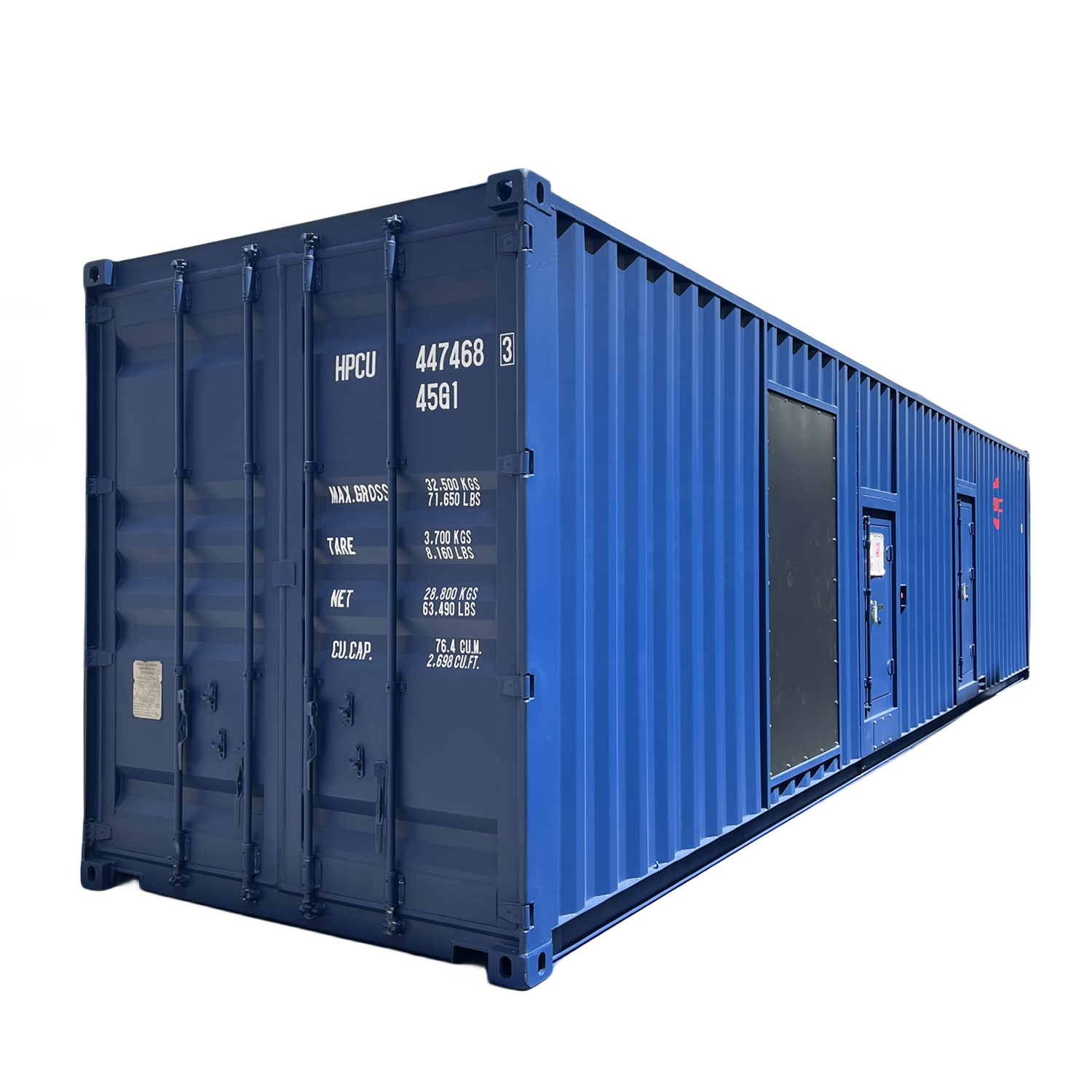
Capital efficiency drives modern data center design. A pre-integrated, factory-tested container type generator offers significant upfront capital savings. You avoid the escalating construction costs associated with building dedicated indoor generator halls. Stick-built rooms often suffer from labor delays and complex architectural zoning. By utilizing a modular approach, you preserve valuable indoor square footage for revenue-generating IT racks and servers.
These external units also excel at facility scalability. You can implement "pay-as-you-grow" phased deployments easily. Facilities can add N+1 modular units sequentially as IT loads increase over time. This modularity prevents you from stranding precious capital in unused capacity on day one. You simply drop in new power units onto prepared concrete pads without disrupting live facility operations or introducing construction dust to pristine server environments.
Acoustic and environmental isolation forms another major advantage. Standard ISO containers feature custom weatherproof enclosures and highly advanced thermal management. They incorporate integrated sound attenuation to meet strict urban noise limits. Achieving 65 dB(A) at 7 meters is entirely feasible. Manufacturers utilize heavy-duty acoustic baffling, motorized louvers, and critical-grade silencers to suppress low-frequency engine rumbles effectively.
Meeting Uptime Institute Tier III and IV mandates requires strict adherence to precise power classification. The Uptime Institute mandates that generators must act as an "Alternative Supply Source" rather than merely emergency standby power. They must run without runtime limitations during extended grid failures. If the primary utility drops, the system must seamlessly take over the full facility burden indefinitely.
Understanding these specific power ratings prevents massive financial waste. Defaulting to Continuous Operating Power (COP) is a frequent engineering pitfall. COP often operates at just 80-90% of a machine's prime power capability. Specifying COP forces you to purchase physically larger, much more expensive engines to cover the required capacity. Instead, engineers now leverage Data Center Power (DCP) and Mission Critical Standby ratings. These compliant alternatives allow 100% load operation under specific reliable-grid assumptions. They provide robust reliability without inflated upfront costs.
Power Rating Standard | Operational Capability | Data Center Application Fit |
|---|---|---|
Continuous Operating Power (COP) | Unlimited hours at a constant 100% load. | Highly expensive; often results in vastly oversized engines. |
Prime Rated Power (PRP) | Unlimited hours at variable loads (averaging ~70%). | Better cost efficiency, but requires careful peak load management. |
Data Center Power (DCP) | Unlimited hours at 100% load assuming a reliable regional utility grid. | Optimal; balances Tier III/IV compliance with practical capital constraints. |
You must also calculate environmental derating aggressively. NFPA 110 guidelines mandate accurate real-world load assessments. Nameplate capacity means very little until you apply specific site variables. Altitude severely impacts engine aspiration. You can generally expect an 8-12% drop in generating capacity per 1,000 meters of elevation. High ambient temperature spikes similarly degrade real-world output. Site engineers must adjust the baseline specifications to account for local environmental extremes.
The mechanical heart of any resilient facility is the standby diesel generator. The core engine requires precise electronic governing and high-pressure common-rail fuel injection. Transient response is incredibly critical in server applications. The system must meet ISO 8528-5 G3 standards to handle sudden, non-linear IT load steps dynamically. It must maintain minimal voltage and frequency deviation. True ISO G3 compliance ensures voltage recovery remains within a tight ±1% margin, preventing downstream UPS batteries from engaging unnecessarily.
Alternator durability directly impacts long-term facility uptime. We highlight several core alternator requirements for mission-critical deployments:
Permanent Magnet Generators (PMG): PMG excitation is absolutely mandatory. It offers superior fault-clearing capabilities and provides excellent immunity to the harsh electrical harmonics generated by UPS systems.
Class H Insulation: Winding insulation must withstand extreme heat. Class H insulation guarantees thermal endurance up to 180°C under heavy, sustained reactive loads.
Anti-Condensation Heaters: For humid environments, integrated heaters prevent winding degradation during prolonged offline periods.
Medium and high-voltage configurations offer distinct systemic efficiency gains. Integrating 10.5kV direct output switchgear inside the container eliminates costly step-up transformer losses. You should pair this topology with High Resistance Grounding (HRG). HRG ensures uninterrupted operation during single-phase ground faults. This advanced electrical setup prevents catastrophic shutdowns and isolates electrical anomalies safely without dropping the load.
Redundancy ensures your facility survives localized mechanical failures. You must map the power plant tightly to your facility's specific electrical topology. Distributed redundancy, such as a 3M2 architecture, pushes hardware utilization to roughly 66.7% across the load paths. This offers a highly efficient financial footprint compared to a traditional N+1 setup. Alternatively, fully fault-tolerant 2N architectures provide ultimate safety but demand massive physical space and higher base operational costs.
Fuel storage requires exact mathematics. You must evaluate the main bulk tank size against the container-integrated daily service tank. A daily tank provides immediate fuel draw for rapid engine starts. Meanwhile, the remote bulk tank guarantees 48 to 72 hours of total site autonomy. Engineers must calculate specific burn rates at peak load to size these tanks accurately.
Tier IV facilities enforce strict physical redundancy rules. You must implement dual, physically separated fuel delivery paths. If one pipe ruptures or clogs, the secondary line takes over instantly. Automated fuel polishing systems are also critical here. They prevent diesel degradation and bacterial growth during long standby periods. Continuous filtration ensures your fuel remains perfectly clean and ready to burn at a moment's notice.
Power generation means nothing without seamless electrical distribution. The ATS cabinet logic serves as the true lifeline of the facility. It defines the tight synchronization parameters and closed-transition transfer capabilities. Closed-transition functionality acts as a "make-before-break" switch. It allows heavy loads to move seamlessly between the active grid, the UPS batteries, and the generator without ever dropping the critical IT bus.
In an absolute worst-case scenario, you face a total facility dark-start. This is where a robust black start power system proves its immense worth. Standard startup sequences rely on some baseline facility power. A black start bootstraps the entire plant from zero volts. Key fundamentals include:
Independent DC battery banks separated from the main facility UPS.
Pneumatic or hydraulic starting redundancies in case standard electric starter motors fail.
Automated step-load sequencing to reboot the massive facility chillers and servers systematically without stalling the prime mover.
Paralleling multiple units requires highly intelligent onboard controllers. They sync several individual units onto a common bus rapidly. If one engine fails to crank, the master controller initiates autonomous load shedding. It strategically drops non-critical mechanical loads, such as administrative HVAC, to protect the delicate server room environment and prevent cascading plant failures.
Evaluating a containerized diesel generator for data center applications requires rigorous bottom-of-funnel scrutiny. You cannot accept simple spec-sheet promises when site uptime is on the line.
First, demand robust Factory Acceptance Testing (FAT). You must witness FAT protocols at full reactive load before the container ever ships. Testing at 0.8 power factor proves the system can handle harsh real-world conditions. Do not accept purely resistive load bank tests, as they do not accurately simulate IT infrastructure behavior.
Next, evaluate local support SLAs and reliability metrics. A prime data center backup generator should target a Mean Time Between Failures (MTBF) exceeding 25,000 hours. You must verify guaranteed response times for OEM parts and certified technicians within your exact geographic region. Hardware reliability drops to zero if localized, rapid-response support remains unavailable during a crisis.
Finally, analyze long-term operational efficiency parameters strictly. Compare vendor proposals based on realistic fuel consumption curves at typical 50-70% operating loads, not just optimal 100% load benchmarks. Review the required preventative maintenance schedules deeply. You want a system that optimizes fuel burn while extending core service intervals, reducing the overall mechanical burden on your ongoing facility operations.
Specifying a containerized diesel generator is an intense exercise in balancing uncompromising Uptime standards with precise component right-sizing. By stepping away from rigid COP standards and leaning into DCP ratings, operators achieve maximum reliability without wasting crucial capital.
To secure your facility's future, follow these actionable next steps:
Move beyond basic spec-sheet comparisons and conduct extensive site-specific load profiling.
Define aggressive Factory Acceptance Testing requirements early in your procurement phase.
Engage directly with qualified OEM engineering teams to map exact fuel routing and thermal limits.
By executing these strategies, you build an impenetrable defense against grid instability and guarantee your critical infrastructure stays online under the harshest conditions.
A: COP (Continuous Operating Power) assumes a constant baseline load indefinitely, often forcing operators to buy larger, expensive engines. DCP (Data Center Power) allows a generator to run at 100% of its rated capacity with no runtime limit, but it assumes the facility operates on a highly reliable utility grid. DCP proves much more cost-effective for modern facilities.
A: Yes, they can. Manufacturers equip these modular units with custom acoustic baffling, motorized louvers, and critical-grade silencers. A properly engineered enclosure easily suppresses noise levels down to 65 dB(A) at 7 meters, satisfying strict urban zoning ordinances without requiring a dedicated concrete hall.
A: An ATS simply switches an active load between two live power sources, like the grid and a running generator. A black start system acts when all facility power is completely lost. It independently bootstraps the power plant from zero voltage using dedicated DC batteries and isolated starters.
A: You must strictly allocate adequate physical clearance to ensure proper equipment longevity and safety. Generally, you need at least 1.5 to 2 meters of space around the enclosure for safe maintenance access. You also must account for unobstructed airflow pathways for massive radiators and adhere to local fire separation codes.