T: +86-139-5050-9685
E: sales@bycpower.com
E: sales@bycpower.com
No. 13, Jincheng road, Tiehu village, Chengyang town, Fuan city, Fujian, China


Views: 0 Author: Site Editor Publish Time: 2026-01-13 Origin: Site


An AC alternator is an essential component in power generation systems, converting mechanical energy into alternating current (AC) electricity. At BYC Power, we manufacture high-quality AC alternators that provide efficient and reliable power for industrial and commercial applications. Understanding how an AC alternator generates alternating current is crucial to ensuring optimal power output and system performance. This article explores the principles of electromagnetic induction, the components involved, and how the AC alternator efficiently generates alternating current.
The key principle behind the operation of an AC alternator is electromagnetic induction, a phenomenon discovered by Michael Faraday. According to Faraday’s law, when a conductor is moved through a magnetic field, it induces an electromotive force (emf) in the conductor. In the case of an AC alternator, mechanical energy is used to spin a rotor, which generates a rotating magnetic field that induces a current in the stator.
Faraday’s law is the foundation of how an AC alternator operates. When the rotor (the rotating part of the alternator) spins, it creates a changing magnetic field around the stator (the stationary part). This changing magnetic flux induces an alternating current in the stator windings. The alternating current alternates direction as the rotor completes each rotation. This process converts mechanical energy into electrical energy, generating AC.
The rotor of the AC alternator is powered by mechanical motion, typically from a diesel engine or other prime mover. As the rotor spins, the magnetic field it generates induces a current in the stator. The speed at which the rotor rotates is directly related to the frequency of the generated AC, meaning that faster rotations produce higher frequencies of alternating current.
The two primary components in an AC alternator that facilitate the generation of alternating current are the rotor and the stator. These components interact to convert mechanical energy into electrical energy.
The rotor is the rotating component of the alternator and is responsible for generating the magnetic field. The stator, which contains coils or windings, is stationary and captures the induced current. As the rotor spins, its magnetic field interacts with the stator’s windings, inducing an alternating current in the stator. This interaction is what ultimately generates AC electricity.
The windings in the stator are made of high-conductivity materials, such as copper, which allow the induced current to flow efficiently. The rotor’s magnetic flux interacts with these windings, creating an electromotive force (emf) that drives the alternating current. The quality of the windings and the rotor’s magnetic field strength play a crucial role in determining the efficiency and output of the AC alternator.
The frequency and voltage of the alternating current produced by the AC alternator are essential factors that determine the power quality and compatibility with the system.
The frequency of the generated AC is directly related to the speed at which the rotor spins. In most AC alternators, the rotor is designed to rotate at a specific speed to produce the desired frequency, either 50Hz or 60Hz, depending on the region. The frequency can be calculated based on the number of poles on the rotor and the rotational speed. Higher rotor speeds result in higher frequencies, and adjusting the rotor speed allows for the generation of the required AC frequency for various applications.
The frequency of the AC output is critical for compatibility with the electrical system being powered. If the frequency is inconsistent or incorrect, it can cause equipment to malfunction or operate inefficiently. Therefore, it is crucial to select an AC alternator that matches the required frequency for your system to ensure optimal performance and reliable power output.
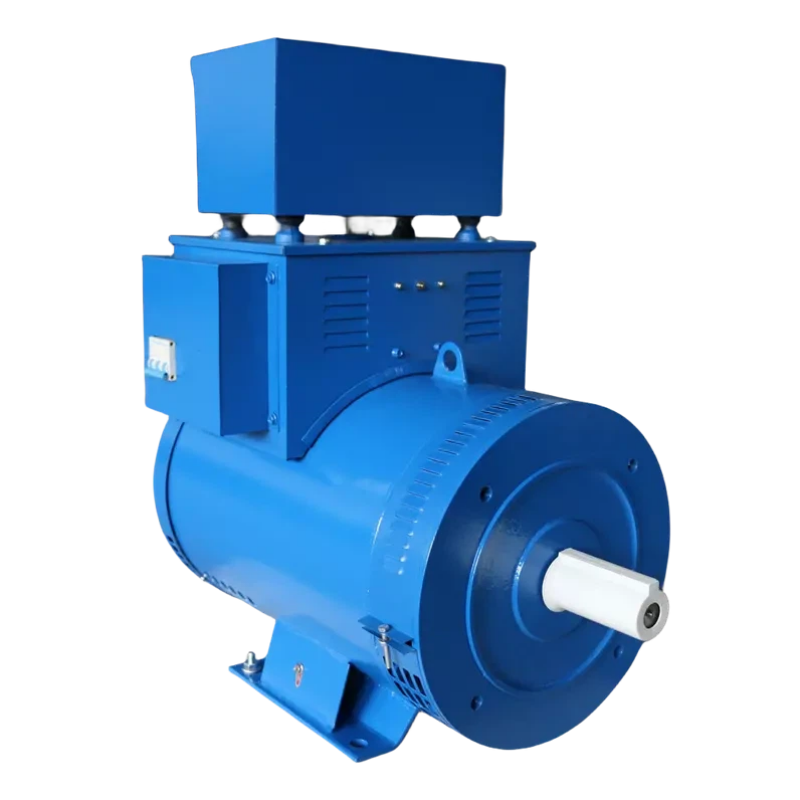
Once the AC alternator generates alternating current, the next step is converting it into usable power for external systems.
AC alternators typically generate alternating current, which is suitable for most industrial and commercial applications. However, there are cases where the generated AC may need to be converted into direct current (DC) for specific applications, such as charging batteries or powering certain devices. A rectifier is used to convert the AC to DC. In most applications, however, the AC generated is used directly for powering equipment.
After the AC alternator generates the electricity, it is transferred to the load system, which could be a factory, a building, or any system requiring power. The AC alternator must be matched with the power requirements of the load, including voltage and frequency. Proper integration ensures efficient power delivery and stable operation of the entire system.
Component | Function | Example Application |
Rotor | Creates a rotating magnetic field | Mechanical energy conversion |
Stator | Induces current in the windings | Electricity generation |
Rectifier | Converts AC to DC (if required) | Battery charging or DC loads |
Voltage Regulator | Maintains stable output voltage | Ensures system reliability |
Alternating current is widely used in power systems around the world, and understanding its advantages is essential when considering AC alternators.
One of the main reasons AC is preferred over direct current (DC) for power transmission is its ability to be easily transformed to different voltage levels. Using transformers, AC can be stepped up to high voltages for long-distance transmission and then stepped down for use in homes, industries, and businesses. This flexibility makes AC more efficient and practical for large-scale power distribution networks.
AC alternators are used in various industrial and commercial applications. In industries, they are used to power large machinery, lighting, and other essential systems. In commercial settings, such as office buildings or shopping malls, AC alternators ensure that electrical systems operate smoothly, even in the event of power outages or when the grid is unavailable. Their ability to generate reliable, stable power makes them indispensable in power systems worldwide.
In conclusion, an AC alternator generates alternating current by utilizing the principles of electromagnetic induction. By converting mechanical energy into electrical energy, AC alternators provide reliable and efficient power for various industrial and commercial applications. Understanding how AC alternators generate alternating current and the factors that influence their performance can help you choose the right alternator for your power generation needs. At BYC Power, we offer AC alternators that are designed to deliver consistent output, efficiency, and reliability for a wide range of applications.
If you need an high-quality AC alternator for your power generation system, contact us today at BYC Power. Our experts are ready to assist you in selecting the ideal alternator for your needs, ensuring you get the most reliable and efficient solution.
1. How does an AC alternator generate alternating current?
An AC alternator generates alternating current by rotating a magnetic field created by the rotor through the stator windings, inducing an alternating current in the stator.
2. What factors affect the frequency of the alternating current?
The frequency of the alternating current generated by an AC alternator is determined by the rotational speed of the rotor and the number of poles on the rotor. Higher speeds produce higher frequencies.
3. Why is alternating current used instead of direct current for power transmission?
Alternating current is preferred because it can be easily transformed to different voltage levels, allowing for efficient long-distance transmission with minimal energy loss.
4. How do rectifiers work in AC alternators?
Rectifiers convert the alternating current (AC) generated by the alternator into direct current (DC) for applications that require DC power, such as battery charging or electronic devices.